


Understanding the Cardiac Vortex: More that just a Heart

Updated: Apr 28

The Heart Is Not a Pump: Understanding the Cardiac Vortex
A Nursing Student Guide for American Heart Month
Introduction: Rethinking How the Heart Works
For decades, nursing and medical education has described the heart as a pump—a muscular organ that squeezes blood forward through four chambers and a series of valves and not fa Cardiac Vortex.
While this explanation is functionally useful, it is structurally incomplete.
Modern anatomical research shows that the heart functions less like a piston and more like a biological vortex generator, using spiral muscle fibers to twist, recoil, and efficiently move blood.
Understanding this concept helps nursing students better grasp:
Cardiac efficiency "👉 Link → Cardiac Output"
Diastolic filling
Heart failure mechanics
CPR and resuscitation physiology

The Helical Heart: The Ventricular Myocardial Band
The concept of the heart as a vortex comes largely from the work of Francisco Torrent-Guasp, who proposed that the ventricular myocardium is:
One continuous muscular band
Folded and twisted into a double-helix configuration
Wrapped to form both ventricles
What Happens When the Heart Is “Unrolled”?
When carefully dissected and unfolded:
The ventricular muscle forms a long spiral band
Fibers run obliquely—not horizontally
The structure resembles a helical ribbon, not stacked layers
This architecture allows the heart to:
Twist during systole
Store elastic energy
Recoil during diastole
This motion is called cardiac torsion.

Blood Flow Is Spiral, Not Straight
Advanced imaging (including Doppler echocardiography and cardiac MRI) demonstrates that blood inside the ventricles moves in a vortical (spiral) flow pattern.
Why This Matters
Spiral flow:
Reduces turbulence
Improves ejection efficiency
Conserves kinetic energy
Supports ventricular filling
For nursing students, this reframes cardiac output as a fluid dynamics problem, not just pressure and volume.
Systole and Diastole: A Wringing Motion
Instead of thinking:
“The heart squeezes blood out”
Think:
“The heart twists, ejects, and recoils”
During Systole
Muscle fibers contract in a spiral
The apex and base rotate in opposite directions
Blood is ejected through a vortex-assisted outflow
During Diastole
Elastic recoil untwists the ventricle
This creates suction
Blood is actively drawn into the chamber
This explains why diastole is not passive, a common misconception among early learners.
Clinical Relevance for Nursing Practice
Heart Failure
In systolic and diastolic heart failure: 👉 Link → Left vs Right Heart Failure
Torsional motion is reduced
The heart loses its vortex efficiency
Ejection fraction may drop or filling may become impaired
This helps explain why some patients:
Have preserved EF but severe symptoms
Fatigue easily despite “normal” numbers
Post-Myocardial Infarction
Disrupts fiber continuity
Reduces coordinated twisting
Alters intraventricular flow patterns
This contributes to ventricular remodeling.
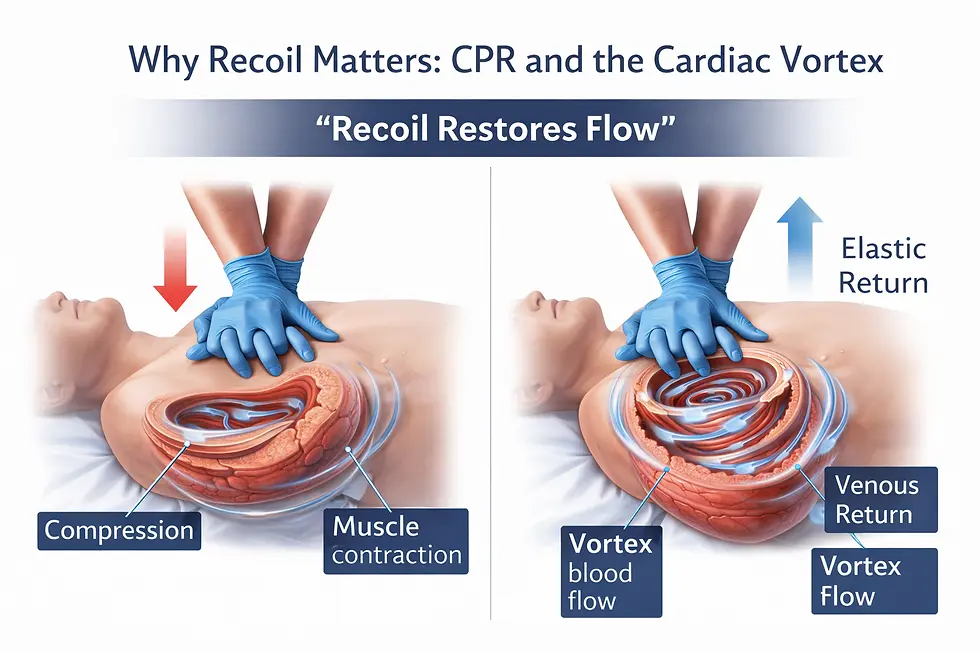
CPR, BLS, and the Attempt to Restore the Vortex
For students learning BLS and CPR, this concept matters more than it first appears.
Effective chest compressions aim to:
Generate pressure gradients
Encourage forward flow
Allow full chest recoil
Full recoil is critical because:
It restores elastic return
Supports venous return
Helps recreate the twist–release cycle
You’re not just “pumping blood”—you’re trying to restart organized flow.
Why This Perspective Is Often Missing From Textbooks
This model is not commonly emphasized because:
It is difficult to represent in 2D diagrams
Traditional teaching favors mechanical simplicity
Spiral flow is a fluid dynamics concept, not just anatomy
However, modern cardiology increasingly recognizes the heart as a dynamic, torsional organ, not a static pump.
Key Takeaways for Nursing Students
The heart functions as a helical vortex generator
Ventricular muscle fibers twist, not just squeeze
Blood moves in spiral flow patterns
Diastole is active and energy-efficient
Loss of torsion contributes to heart failure
CPR relies on recoil and pressure—not brute force
Understanding this improves:
Clinical reasoning
ECG interpretation context
Cardiac assessment insight

🧠 Want to Go Deeper?
Understanding how the heart moves blood is just the beginning. Build your clinical knowledge with these related topics:
Understanding Cardiac Output: Why the Heart Fails Before It Stops
Left-Sided vs Right-Sided Heart Failure: A Clinical Guide
Acute Coronary Syndrome (ACS): What Nursing Students Must Recognize
Hypertension: The Silent Killer Every Nursing Student Must Understand
Medical & Educational Disclaimer
This content is intended for educational purposes only and is designed to support nursing and healthcare students in understanding cardiovascular physiology. It is not a substitute for professional medical advice, diagnosis, or treatment. Always follow institutional protocols and evidence-based guidelines when providing patient care.
💡 Ready to Get Certified?
Be prepared. Be confident. Learn First Aid Today & Save a Life Tomorrow with Saving Grace Medical Academy Ltd. Now enrolling: Basic Life Support (BLS) & Standard First Aid CPR-C & AED courses designed for healthcare professionals.
📍 Training for First-Year Nursing Students
Join Saving Grace Medical Academy Ltd. for fully certified, CSA-compliant Standard First Aid CPR-C & AED courses—designed for Alberta’s future healthcare professionals.
Just Remember:
Protect Yourself. Call 911.Don’t Waste Time.

RESOURCES:

Author - Saving Grace Medical Academy Ltd
Grace. T
Medical Content Writer


