


Cannabis, Anesthesia and Medication Interactions: Why Honest Disclosure Can Improve Patient Safety

Updated: Jul 23

Cannabis Before Surgery: Why Honest Disclosure Can Improve Patient Safety
Why This Matters to Nursing Students:
As cannabis becomes increasingly accessible across Canada, healthcare professionals are seeing more patients who use cannabis recreationally, medically or both.
Many people assume that because cannabis is legal, it has little impact on medical care. Others worry they may be judged if they disclose cannabis use before a procedure.
Neither assumption is true.
Cannabis is clinically relevant, not because healthcare providers are interested in personal lifestyle choices, but because cannabinoids can influence how some patients respond to sedation, anesthesia, pain medications and other treatments.
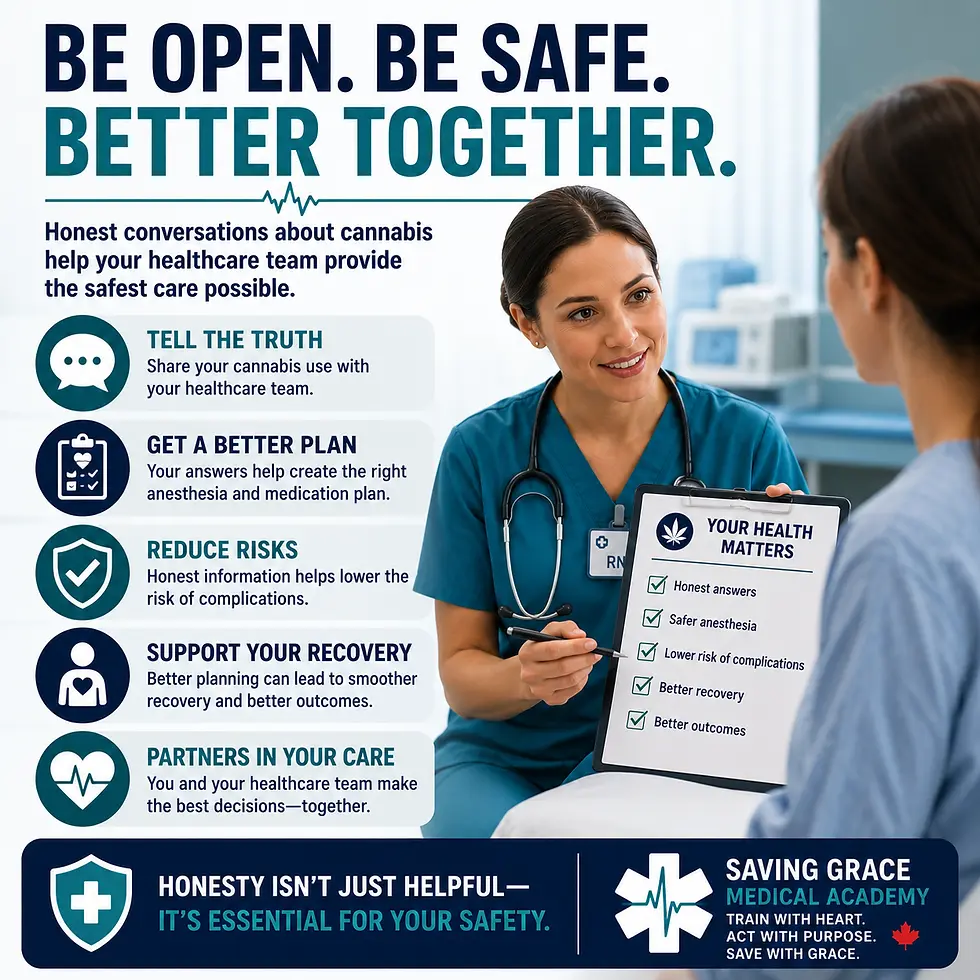
Whether you use cannabis daily, occasionally or only for medical reasons, your healthcare team needs accurate information to provide the safest care possible.
The goal of this article is not to discourage cannabis use or promote it. Instead, we'll explore what current research tells us, separate fact from fiction, and explain why honest communication with healthcare professionals is one of the simplest ways to improve patient safety.
Medical Disclaimer
This article is intended for educational purposes only and should not replace assessment, diagnosis or treatment by a qualified healthcare professional. Medical recommendations vary depending on an individual's health history, medications and the procedure being performed. If you are scheduled for surgery or a medical procedure requiring sedation or anesthesia, always follow the instructions provided by your healthcare team.
What Is Cannabis?
Cannabis contains more than one hundred naturally occurring compounds known as cannabinoids, but two receive the greatest medical attention.
THC (Tetrahydrocannabinol)
THC is the primary psychoactive component responsible for the "high" associated with cannabis. Depending on the dose, route of administration and the individual, THC may produce:
Relaxation
Altered perception
Impaired coordination
Increased heart rate
Anxiety or panic
Drowsiness
Changes in blood pressure
CBD (Cannabidiol)
CBD does not produce the same intoxicating effects as THC but is still biologically active. It may influence liver enzymes responsible for metabolizing certain medications and has documented interactions with several prescription drugs.
Not all cannabis products are the same. Smoked cannabis, vaporizers, edible products, oils, capsules and prescription cannabinoid medications can differ significantly in onset, duration and clinical effects.

Why Healthcare Providers Ask About Cannabis Use
One of the biggest misconceptions patients have is believing that healthcare providers ask about cannabis because they are judging the patient.
Nothing could be further from the truth.
Healthcare providers ask because cannabis can influence medical decision-making.
For example, clinicians may need to know:
Could this patient require a different sedation plan?
Are today's symptoms caused by cannabis, or is another medical emergency developing?
Could cannabis interact with prescribed medications?
Is the patient's airway at greater risk during anesthesia?
Is the patient able to provide informed consent?
These questions help clinicians provide safer care—not judge personal choices.
Cannabis and Medical Assessment
Cannabis does not automatically change laboratory results or make diagnostic tests inaccurate.
However, it can change how symptoms are interpreted.
Cannabis use may contribute to:
Increased heart rate
Blood pressure changes
Anxiety
Dizziness
Altered mental status
Sedation
Nausea and vomiting
Impaired coordination
These symptoms can resemble many serious medical conditions.
A patient who uses cannabis can still experience:
Heart attack
Stroke
Sepsis
Hypoglycemia
Pulmonary embolism
Meningitis
Serious trauma
Healthcare professionals must avoid diagnostic anchoring, where an early assumption prevents consideration of more dangerous diagnoses.

What Is Diagnostic Anchoring?
Diagnostic anchoring occurs when a clinician focuses too quickly on one possible explanation while overlooking other potentially life-threatening conditions.
Example
A patient arrives in the emergency department with chest pain after using cannabis.
An inexperienced clinician may think:
"It's probably just anxiety from cannabis."
An experienced clinician thinks differently.
The patient could still be experiencing:
Acute Coronary Syndrome (ACS)
Pulmonary Embolism
Aortic dissection
Myocarditis
Pneumothorax
Severe anxiety related to cannabis
Good clinicians keep an open differential diagnosis until evidence supports a conclusion.
Cannabis and Colonoscopy
One of the most discussed areas of recent research involves colonoscopy and procedural sedation.
Many colonoscopies are performed using medications such as propofol, fentanyl and midazolam.
Several studies have shown that regular cannabis users may require higher doses of some sedation medications compared with non-users.
This does not mean sedation will fail.
Instead, cannabis use may make sedation requirements more variable or increase the amount of medication needed to achieve the desired level of comfort.
Patients should always inform the gastroenterology and anesthesia teams if they use cannabis regularly, including:
How often they use it
Whether it contains THC, CBD or both
How it is consumed
When it was last used
This information helps clinicians individualize sedation and monitor for potential complications.

Cannabis and Anesthesia
Anesthesia providers routinely ask patients about alcohol, tobacco, prescription medications, supplements and recreational substances.
Cannabis belongs on that list.
Current evidence suggests cannabis use may influence:
Sedation requirements
Airway management
Heart rate
Blood pressure
Post-operative pain control
Recovery from anesthesia
Post-operative nausea and vomiting
Withdrawal symptoms in frequent users
Patients who arrive for surgery while acutely intoxicated may have their elective procedure postponed because intoxication can interfere with informed consent and safe anesthetic management.
The key message is simple:
Never hide cannabis use from your anesthesia provider.
Cannabis and Medication Interactions
Cannabis does not automatically become dangerous when combined with other medications, but some combinations require additional caution.
Medications that may increase sedation
Cannabis may add to the sedating effects of:
Opioids
Benzodiazepines
Sleep medications
Alcohol
Sedating antihistamines
Some anti-seizure medications
General anesthetics
CBD and Liver Enzymes
CBD can influence liver enzymes involved in drug metabolism.
Documented interactions have been reported with medications including:
Clobazam
Valproate
Other medications may also be affected depending on the dose, product and individual patient.
Patients should always disclose CBD products, even if purchased over the counter.

Truth vs Fiction
Fiction
"Cannabis makes anesthesia completely ineffective."
Current evidence does not support this claim.
Some patients require higher doses of sedative medications, but anesthesia remains effective when properly managed.
Truth
"Your anesthesiologist should know if you use cannabis."
Absolutely.
Knowing about cannabis use helps the anesthesia team provide safer, individualized care.
Fiction
"Because cannabis is legal, it isn't medically important."
Legal status does not determine medical relevance.
Cannabis can influence anesthesia, medications, cardiovascular function and recovery.
Fiction
"A positive urine cannabis test proves someone is currently impaired."
Urine testing generally confirms previous exposure—not current intoxication or impairment.
Clinical assessment remains essential.
Truth
"CBD can interact with some prescription medications."
Yes.
Although CBD is not intoxicating, it remains pharmacologically active and may alter how some medications are metabolized.
Nursing Considerations
Healthcare professionals should:
Obtain a respectful, nonjudgmental substance-use history.
Ask about THC, CBD, route, frequency and time of last use.
Avoid diagnostic anchoring.
Assess airway, cardiovascular status and mental status.
Recognize that cannabis users can still experience unrelated medical emergencies.
Monitor carefully during sedation and recovery.
Encourage honest communication without stigma.

Continuing Education: Would You Like to Know More?
Expand your understanding of patient assessment, pharmacology and evidence-based healthcare with these related SGMA articles:
🌿 Cannabis: Understanding the Medical Benefits, Risks and Common Myths
Learn how cannabinoids affect the body, the difference between THC and CBD, common misconceptions, and the current evidence surrounding medical and recreational cannabis use.
💉 Methylene Blue: Uses, Benefits and Clinical Considerations
Discover how methylene blue is used in modern medicine, including its role in treating methemoglobinemia, vasoplegic shock and selected toxicological emergencies, along with important medication interactions and contraindications.
❤️ Shock Explained: Recognition, Stages and Emergency Management
Build your understanding of compensated, decompensated and irreversible shock while learning how early recognition and treatment improve patient outcomes.
🩸 Diabetes Emergencies: Recognizing DKA, HHS and Hypoglycemia
Explore how altered mental status, dehydration and metabolic emergencies can mimic other conditions, reinforcing the importance of a thorough patient assessment and avoiding diagnostic anchoring.
🧬 The Endocrine System: Hormones, Homeostasis and Endocrine Emergencies
Review how hormones regulate nearly every body system and learn about life-threatening endocrine emergencies that healthcare professionals must recognize quickly.
Case Scenario
A 52-year-old patient arrives for an elective colonoscopy. During the pre-procedure assessment, they mention using cannabis gummies most evenings to help with chronic back pain. They also report smoking cannabis earlier that morning because they felt anxious about the procedure.
Their heart rate is 112 beats per minute, blood pressure is mildly elevated and they appear calm but admit they still "feel a little high."
The anesthesia provider now has important information that may influence the timing of the procedure, informed consent, cardiovascular assessment and the sedation plan.
Without this disclosure, the healthcare team would have been missing a significant piece of the clinical picture.
Test Your Knowledge
1. Why should patients disclose cannabis use before anesthesia?
A. It automatically cancels surgery.
B. It may influence anesthesia planning and medication requirements.
C. It is required for insurance purposes.
D. Cannabis has no effect on anesthesia.
Answer: B
2. Does a positive urine cannabis screen prove current impairment?
A. Yes
B. Only if symptoms are present
C. No
D. Only within 24 hours
Answer: C
3. Which cannabinoid has documented interactions with certain prescription medications?
A. THC only
B. CBD
C. Terpenes
D. None
Answer: B
4. What is diagnostic anchoring?
A. Repeating the same assessment twice.
B. Confirming every diagnosis with imaging.
C. Focusing too quickly on one explanation while overlooking other possibilities.
D. Performing unnecessary tests.
Answer: C
Key Takeaways
Cannabis use is medically relevant, particularly before procedures requiring sedation or anesthesia.
Honest disclosure allows healthcare professionals to individualize care.
Cannabis does not make anesthesia ineffective, but some patients may require different medication strategies.
CBD products can interact with certain prescription medications.
A positive urine cannabis test does not prove current impairment.
Good clinicians avoid diagnostic anchoring and continue evaluating all possible causes of a patient's symptoms.
Final Thoughts
Healthcare professionals are not asking about cannabis to judge your choices—they are asking because every medication, supplement and substance has the potential to influence patient care.
Whether the substance is cannabis, CBD, alcohol, prescription medication or an over-the-counter supplement, the safest healthcare begins with an honest medical history.
The most valuable tool in medicine is often not a laboratory test or imaging study.
It's an accurate conversation between the patient and the healthcare team.
💡 Ready to Get Certified?
Be prepared. Be confident. Learn First Aid Today & Save a Life Tomorrow with Saving Grace Medical Academy Ltd. Now enrolling: Basic Life Support (BLS) & Standard First Aid CPR-C & AED courses designed for healthcare professionals.
📍 Training for First-Year Nursing Students
Join Saving Grace Medical Academy Ltd. for fully certified, CSA-compliant Standard First Aid CPR-C & AED courses—designed for Alberta’s future healthcare professionals.
Just Remember:
Protect Yourself. Call 911.Don’t Waste Time.

RESOURCES:

Author - Saving Grace Medical Academy Ltd
Grace. T
Medical Content Writer


