


Autism Spectrum Disorder: Understanding the Levels, Support Needs, and Masking in Real Life


Autism Spectrum Disorder: Understanding the Support Needs, and Masking.
Autism Spectrum Disorder (ASD) is not a single presentation—it is a spectrum of neurological differences that affect communication, behavior, and sensory processing.
For nursing students and healthcare professionals, understanding how autism is medically classified—and how it presents in real life—is essential for providing safe, compassionate care.
Why This Matters in Healthcare
Autistic individuals may present in emergency or clinical settings with:
Communication barriers
Sensory sensitivities
Misinterpreted behaviors (e.g., avoidance mistaken as non-compliance)
Understanding how autism is scaled helps healthcare providers:
Adjust communication strategies
Recognize distress vs defiance
Provide patient-centered care

How Autism is Medically Classified (DSM-5 Levels)
The DSM-5 classifies Autism Spectrum Disorder into three levels based on support needs, not intelligence or worth.
Level 1 – Requiring Support
(Often previously referred to as “high functioning”)
Common Characteristics:
Difficulty with social cues (eye contact, tone, body language)
Challenges initiating or maintaining conversations
Preference for routine and predictability
May appear independent but struggles internally
Clinical Insight: These individuals are often misunderstood because their challenges are less visible.
Level 2 – Requiring Substantial Support
Common Characteristics:
Noticeable verbal and non-verbal communication difficulties
Limited social interaction
Repetitive behaviors more apparent
Distress with changes in routine
Clinical Insight: Support is needed more consistently, especially in unfamiliar environments like hospitals.
Level 3 – Requiring Very Substantial Support
(Often includes non-verbal individuals)
Common Characteristics:
Minimal or no verbal communication
Significant difficulty with social interaction
High sensitivity to sensory stimuli
May use alternative communication methods (AAC devices, gestures)
Clinical Insight: These individuals are often labeled “low functioning,” but this term does not reflect intelligence or emotional depth—only the level of support required.
The Spectrum in Practice: It’s Not Linear
Autism is not a straight line from “mild” to “severe.” It is a multi-dimensional spectrum that includes:
Communication ability
Sensory sensitivity
Emotional regulation
Cognitive processing
An individual may be highly verbal but extremely sensitive to sensory input—or non-verbal with strong emotional awareness.
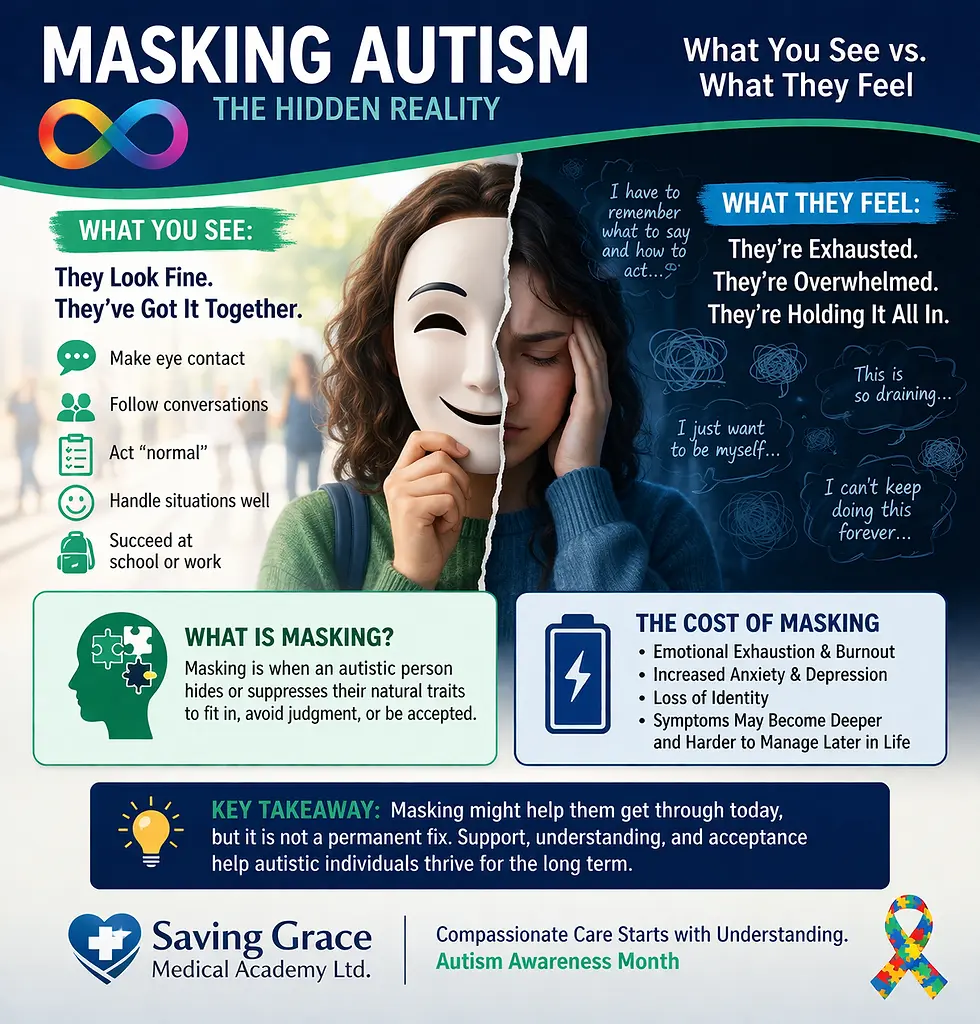
Masking: The Hidden Layer of Autism
One of the most important—and often overlooked—concepts is masking.
Masking refers to when an autistic individual consciously or unconsciously:
Mimics social behaviors
Suppresses natural responses (stimming, avoidance)
Forces eye contact or scripted conversations
Why Masking Happens
To “fit in” socially
To avoid stigma or bullying
To succeed in school or work environments
The Cost of Masking
Masking is not sustainable long-term.
Over time, it can lead to:
Emotional exhaustion (burnout)
Anxiety and depression
Loss of identity
Increased sensory overwhelm
Many individuals who mask heavily in childhood or adolescence may experience more pronounced symptoms later in life when the ability to maintain masking decreases.

Clinical Considerations for Nursing Students
When caring for autistic patients:
1. Communication
Use clear, direct language
Avoid sarcasm or abstract phrasing
2. Environment
Reduce noise, bright lights, and unnecessary stimulation
3. Behavior Interpretation
Repetitive behaviors (stimming) are often self-regulation, not disruption
4. Patience and Time
Allow extra processing time for responses
Home Treatment and Self-Care
For autistic individuals and families:
Maintain consistent routines
Use sensory-friendly environments (quiet spaces, dim lighting)
Encourage safe self-regulation strategies (stimming, weighted items)
Seek supportive therapies when needed (OT, speech therapy, counseling)
Case Scenario
Scenario: A 19-year-old patient presents to the ER with abdominal pain. They avoid eye contact, give short answers, and become visibly distressed when touched without warning.
Question: What is the most appropriate nursing approach?
Answer: Use clear, direct communication, explain all actions before touching, and reduce environmental stressors.
Rationale: This patient may be autistic (Level 1 or 2) and experiencing sensory overload. Adjusting communication and environment improves cooperation and reduces distress.
Final Thoughts
Autism is not a limitation—it is a different way of experiencing the world.
Understanding the levels of support, recognizing masking, and approaching care with empathy and adaptability allows healthcare providers to build trust and deliver better outcomes.
Medical & Educational Disclaimer
This article is for educational purposes only and is intended for nursing students and healthcare learners. It does not replace professional medical diagnosis or treatment. Individuals experiencing symptoms should consult a qualified healthcare provider for assessment and appropriate testing.
💡 Ready to Get Certified?
Be prepared. Be confident. Learn First Aid Today & Save a Life Tomorrow with Saving Grace Medical Academy Ltd. Now enrolling: Basic Life Support (BLS) & Standard First Aid CPR-C & AED courses designed for healthcare professionals.
📍 Training for First-Year Nursing Students
Join Saving Grace Medical Academy Ltd. for fully certified, CSA-compliant Standard First Aid CPR-C & AED courses—designed for Alberta’s future healthcare professionals.
Just Remember:
Protect Yourself. Call 911.Don’t Waste Time.

RESOURCES:

Author - Saving Grace Medical Academy Ltd
Grace. T
Medical Content Writer


